
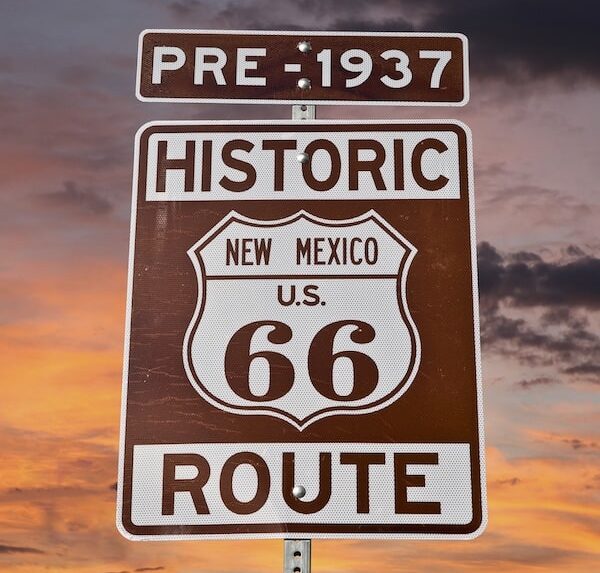
Did you know Santa Fe was on the original Route 66? For a mere 12 years, from 1926 to 1938, Santa Fe was on the circuitous route through New Mexico, coming into town from Santa Rosa, over Glorieta Pass (where I-25 now goes through) to the Old Pecos Trail, where we are now. The route wound it’s way through downtown, south along Cerrillos Rd and Agua Fria St, down the crazy switchbacks of La Bajada Hill, then on to ABQ.
Fun fact: Back before cars had fuel pumps, they had to travel up La Bajada Hill backwards to keep gas going to the engine
Route 66 crossed New Mexico for more than 600 miles, leaving one of the deepest cultural footprints of the entire highway. When the road was officially designated in 1926, New Mexico—still adjusting to statehood in 1912—saw Route 66 as a vital link between its isolated towns and the wider U.S. economy. The highway stitched together a string of railroad communities, trading posts, pueblos, and ranching towns, helping turn the state into a crossroads of tourism, commerce, and migration.
New Mexico became the first state to completely pave Route 66 in 1937 and at the same time approved a major realignment. The route that is used today, from Tucumcari to ABQ, is a lot quicker and easier to maintain than the slow, mountainous and difficult to maintain route through Santa Fe. The highway was rerouted to bypass Santa Fe entirely, running directly east–west between Albuquerque and Santa Rosa. This new alignment was shorter, flatter, and better suited for fast automobile travel. While Santa Fe lost through-traffic, towns like Moriarty, Tucumcari, and Gallup flourished as classic Route 66 communities.
During the Route 66 heyday (1930s–1950s), the New Mexico stretch became famous for its neon-lit motels, trading posts, roadside diners, and Pueblo and Hispanic cultural influences. The road carried Dust Bowl migrants westward, soldiers during World War II, and postwar tourists chasing the romance of the open road.
Route 66 was officially decommissioned in 1985, replaced largely by Interstate 40, but New Mexico has preserved more drivable historic segments than any other state. Today, both the Santa Fe alignment and later reroutes are celebrated as part of the state’s layered transportation history—where ancient trails, railroads, and highways all overlap in the high desert landscape.
Interested in staying at our Santa Fe motor lodge? Book Now And Save!